

Prologue – The Ciudad

Even for the wraiths, it was a miserable night to be crawling out of a garbage container. Alex stood under the eave of his doorway, sheltering from the rain to savour a cigar. His quiet study of the chipped marble stairs and the filigree of the iron-plated door was arrested by their sudden, unheralded emergence. They multiplied and fanned out. A perturbing interruption to his immersed apprising of the facade. He slipped a hand into his pocket, his fingers closing around the two gangling skeletons that Argentine’s called keys. Medieval artifacts. One for the deadbolt. One for the main lock. The king and the queen.
The shadows darted this way and that, circling closer. He swiftly inserted the king above and the queen below, the locks turning in checkmate with a satisfying click. He pulled the door soundly shut just as a shadow slewed forth onto the verge. The thrum and drum of the downpour abruptly flattened into an unnatural silence as the doorway became engulfed in a lumbering darkness. Moments later, from his balcony, he scanned the street, his eyes searching for the forms he’d just seen. But his gaze was drawn inexorably north, past the immediate streets and toward the horizon. There it was: downtown Buenos Aires, esa hermosa enfermedad, vomited across the landscape under a bruised sky
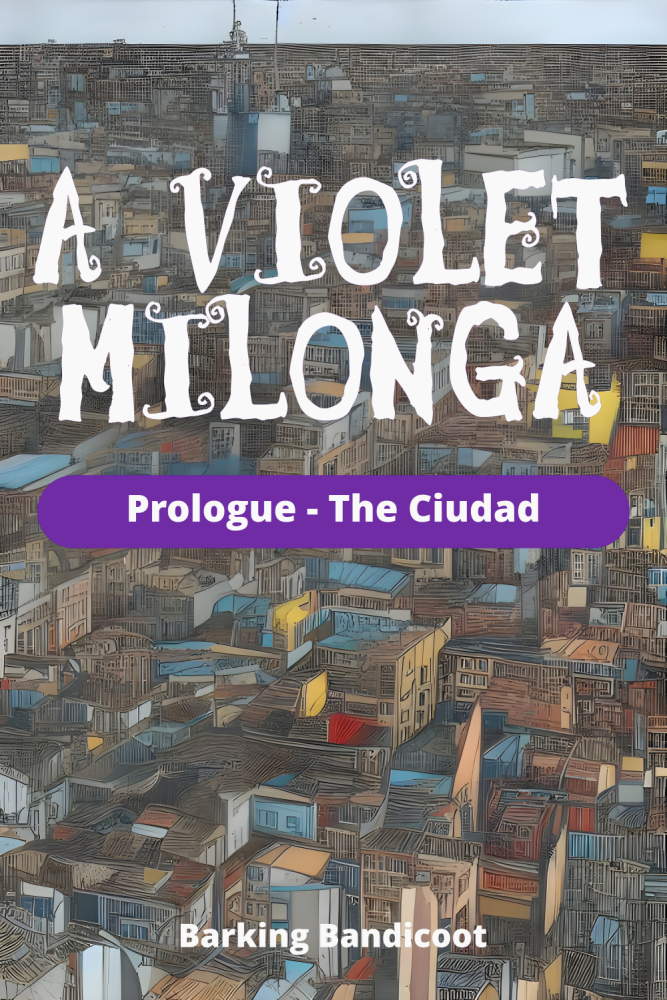
Buenos Aires, a city of fractures, a place of grand European avenues crumbling into forgotten cobblestone alleys. A tapestry of panaderías and heladerias amongst majestic edificios. A fallen duchess. It struts and preens in its Parisian drag. A wonder land. A trash can. An endless promise. A cacophony of pelting buses. Buenos Aires is not a city. It is a sprawling, fever-dream where civilization’s tango with el diablo replays in an eternal danse macabre.
In a city whose proud boulevards are the varicose veins of a utopian corpse, a mate infused tribe of ghosts fucks in the rubble of their ancestors’ dreams, channeling their raw, vain desire for greatness into the desperate clutch of an amuleto, a chanted prayer for continued World Cup glory.
Buenos Aires itself is in constant, maddening flux. Nothing is fixed. Shops open and close on a whim, their hours a suggestion, not a promise. By day, a street might be a vibrant artery of commerce; an elderly hombre buys a newspaper from his local corner stand while a senorita disappears into a second-hand bookstore and two businessmen gesture for cortados at a weathered cafe notable. By night it’s a sterile metallic canyon, as the roller doors grind down, obscuring the windows and Fileteado signage, cloaking the private worlds of the porteños in a shell of steel and shadow. Then, turning a corner, you’re hit by a thump of music and the greasy smell of Super Panchos from a kiosko, a desperate pulse of life in the city’s veins as a line snakes outside a nightclub, pulsing well into the Madrugada.
Under a canopy of broad, leathery leaves that scatter a jigsaw of light and shadow across the sidewalk, you can pass down the same block three times in one day and have three different experiences, because the ground itself is never the same. A common bike path disappears overnight, a familiar sidewalk is suddenly a trench of mud and rebar. A morning meander to a café is abruptly cut short by towering metal shields as police erect an impenetrable fortress, strangling a block where pedestrians and traffic usually know no bounds. A city in metamorphosis, perpetually under construction and deconstruction, a body that is forever healing itself while it splinters apart in other areas.
Yet, the past is always bleeding through like the iron tracks of a long forgotten tram route, rusty scars through the cobblestones of the back streets. Like the silent gas lamp posts that remain vigilant in historical parks, their form and shadows an illumination of a past era. Like the lonely stilled sentinels, those mini Tour Eiffels, the cranes that hang over the canals of Puerto Madero. This is the city’s true nature: a frantic dance between what it is trying to become and what it can never escape.
Alex stood on his balcony, puling down further his frayed flat cap against the spattering rain. The street below was a vale of shadows, but his eyes had adjusted. He scanned the darkness, looking for the tell-tale shimmer, the tear in the fabric of the night. And then he saw it. Not a wraith, but a figure – a silent sentinel under the sputtering jaundiced glow of a lonely streetlamp. He was shouldering a bandoneon, its black lacquer case thirstily absorbing the light.
Then, from seemingly nowhere, like a radio signal lost between channels, came the sound of a mournful harmonica —a single, doleful note. At the sound, the figure with the bandoneon vanished. Not into the shadows, but simply gone, as if he had been erased.
Alex hastily snubbed out the corpse of his cigar and retreated inside, closing the shutters on the fetid night – and the question that now hung in the air along with the lingering smoke.